


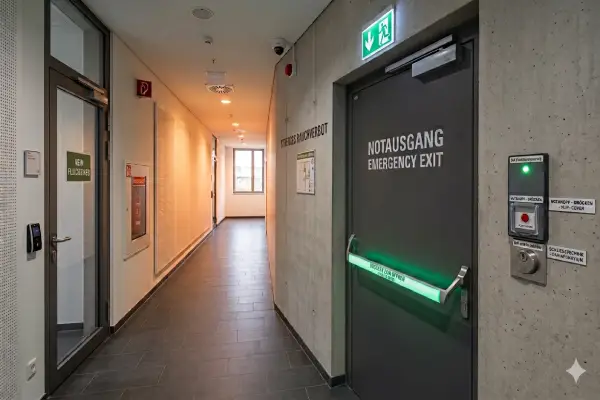
But what regulations actually apply? When are door closers required? And what do the various panic functions A to D mean? This article gives an overview.
What are escape routes?
Escape routes are specially designated paths that allow people to leave a building quickly and safely in an emergency. They usually lead outside or to a secured area.
An escape route includes, among other things:
- Corridors
- Stairwells
- Emergency exits
- Escape doors
- Doors within the escape route
Every single door plays an important role here. It must be able to be opened at all times – even when it is locked.
What regulations apply to escape doors?
Which requirements apply depends on how the building is used.
Residential buildings
In single- and two-family homes, comparatively few requirements apply to locking technology. The situation is different for multi-family buildings. Here, requirements arise, for example, from:
- State building codes
- Special building regulations
- Fire protection concepts
Public buildings
In schools, government offices, hospitals or shopping centers, significantly stricter regulations apply. Among others, the following standards are used here:
- DIN EN 179 for emergency exit locks
- DIN EN 1125 for panic exit devices
- DIN EN 1154 for door closers
- DIN EN 13637 for electrically controlled escape doors
In addition, requirements from the building authority, the fire department or the fire protection report may apply.
Escape doors must always be able to be opened from the inside
One basic rule applies almost always:
An escape door must never lock people in.
That is why it must always be possible to open it from the escape side without a key.
How the door is opened depends on its use:
- Door handle
- Push plate
- Panic bar
- Panic push bar
Which solution is permitted depends on the group of people expected to use it.
DIN EN 179 or DIN EN 1125?
This is often confused.
DIN EN 179
This standard applies to areas where users are familiar with the building.
Typical examples:
- Office buildings
- Workshops
- Operating rooms
- Storage areas
Here, a door handle or push pad is usually sufficient.
DIN EN 1125
This standard applies everywhere many people or people unfamiliar with the location are present.
For example:
- Shopping centers
- Schools
- Event venues
- Hotels
- Airports
Here, panic bars or push bars must be installed so that the door can be opened intuitively.
Panic locks – the four function classes A to D
Panic locks differ not only in their approval, but also in how they behave in everyday use.
Panic lock A – reversible function
On the outside, the door is generally locked.
From the inside, it can be opened at any time via the lever handle.
After closing, the lock automatically locks again.
Typical areas of use
- Side entrances
- Technical rooms
- Staff areas
Panic lock B – switch function
On the outside, the door can be opened temporarily via the lever handle.
After being operated from the inside, the lock switches back to the secured state.
This function is suitable for buildings with changing operating hours.
Panic lock C – access function
On the outside, the lever handle remains permanently engaged.
The door can be opened from both sides as long as it is not locked.
Suitable for areas with high foot traffic during opening hours.
Panic lock D – split function
On the inside, the door always has an escape function.
On the outside, access can be controlled via cylinders, fittings or access control systems.
This solution is often combined with electronic locking systems.
Door closers on escape doors
Door closers fulfill several important tasks.
They ensure that doors close automatically after being passed through. As a result:
- Smoke compartments are preserved
- Fire compartments remain effective
- Escape routes stay clear
- Doors do not accidentally remain open
Door closers are often essential, especially on fire doors.
Door closers on escape doors
Fire doors can only provide their protective effect when they are closed.
If a fire door is left open, smoke and fire can spread within minutes.
That is why approvals for fire doors often require a suitable door closer in accordance with DIN EN 1154.
If a fire door is to be permanently held open, an approved hold-open system is additionally required. This holds the door open during normal operation and closes it automatically as soon as smoke detectors are triggered.
A simple door wedge or a wooden block under the door, on the other hand, is not permitted and can have significant legal consequences in the event of damage.
„In the event of a fire in an underground garage, flue gases can spread through the stairwell and poison the residents. In addition, this also causes the escape routes to fill with smoke.“
Bernhard Schuhmacher, fire protection expert at DEKRA, DEKRA press information Escape Routes
Electric escape door systems
Modern buildings increasingly rely on electric locking systems.
These enable, for example:
- Access control
- Time tracking
- Alarm systems
- Burglary protection
In an emergency, however, these systems must unlock automatically. DIN EN 13637, among other things, forms the basis for this.
Electric escape door controls are often connected to:
- Fire alarm systems
- Smoke detectors
- Emergency stop buttons
- Building management systems
connected.
Common mistakes with escape doors
In practice, the same defects keep occurring:
- Escape doors are locked and the key is removed.
- Fire doors are held open with wedges.
- Door closers are removed or incorrectly adjusted.
- Fittings are replaced without approval.
- Subsequently installed locking systems impair the escape function.
- Maintenance is not carried out regularly.
Even small changes can cause a door to lose its approval.
Maintenance is mandatory
Escape doors and their locking technology should be checked regularly. Among other things, this concerns:
- Function of the panic locks
- Locking mechanism
- Door closers
- Hinges
- Hold-open systems
- Electric escape door controls
Many manufacturers recommend maintenance at least once a year. Shorter intervals may be required for heavily frequented buildings.
Conclusion
Escape routes are far more than marked doors. Only the right locking technology ensures that people can get outside quickly in an emergency while the building remains reliably secured.
Whether panic lock, door closer or electronic escape door control – all components must be coordinated with one another and comply with applicable standards. Especially with fire doors, no changes should be made without expert review, since even small interventions can impair the protective effect.
Anyone planning, modernizing or maintaining escape doors should therefore always pay attention to approved products and professional installation. Only in this way do escape routes fulfill their most important task: safely leading people out of the building in an emergency.
Sources:
- ASR A2.3 – Escape routes and emergency exits
https://www.baua.de/DE/Angebote/Rechtstexte-und-Technische-Regeln/Regelwerk/ASR/ASR-A2-3.html - Workplace Ordinance (ArbStättV)
https://www.gesetze-im-internet.de/arbst_ttv_2004/ - Model Building Code (MBO)
https://www.bauministerkonferenz.de/ - German Institute for Standardization (DIN) – standards research
https://www.din.de/ - DIN EN 179 – Emergency exit locks (standards portal)
https://www.dinmedia.de/ - DIN EN 1125 – Panic exit devices (standards portal)
https://www.dinmedia.de/ - DIN EN 1154 – Door closers (standards portal)
https://www.dinmedia.de/ - DIN EN 13637 – Electrically controlled escape door systems (standards portal)
https://www.dinmedia.de/ - German Statutory Accident Insurance (DGUV) – Publications
https://publikationen.dguv.de/ - Federal Institute for Occupational Safety and Health (BAuA)
https://www.baua.de/ - German Institute for Building Technology (DIBt)
https://www.dibt.de/ - GEZE – Expertise on escape and rescue route systems
https://www.geze.de/ - dormakaba – Solutions for escape and rescue routes
https://www.dormakaba.com/de-de - ASSA ABLOY – Escape route security and panic locks
https://www.assaabloy.com/de - BKS GmbH – Panic locks and escape door systems
https://www.g-u.com/de/DE/marken/bks
Image: AI-generated with Gemini